Choosing between batch and continuous systems
Machine selection is one of the most expensive and strategic decisions in surface preparation. Yet many buying decisions are still made using only brochure capacity and initial price. This usually leads to mismatch: either a machine that is too rigid for product variability, or a machine that is too flexible for high-volume flow requirements.
The right question is not which technology is superior in general. The right question is which machine architecture fits your production behavior, quality commitments, manpower profile, and growth plan.
Batch systems and continuous systems both deliver high-quality blasting when chosen correctly. The difference lies in process fit, not branding claims.
Understand your production reality first
Before comparing equipment, map your existing workflow. Capture part mix, volume variability, loading constraints, shift patterns, downstream painting flow, and rework drivers. This reveals the true operating environment in which the machine must perform.
Without this mapping, selection teams often overestimate stable demand and underestimate handling bottlenecks. The result is overinvestment or underperformance.
Where batch systems create maximum value
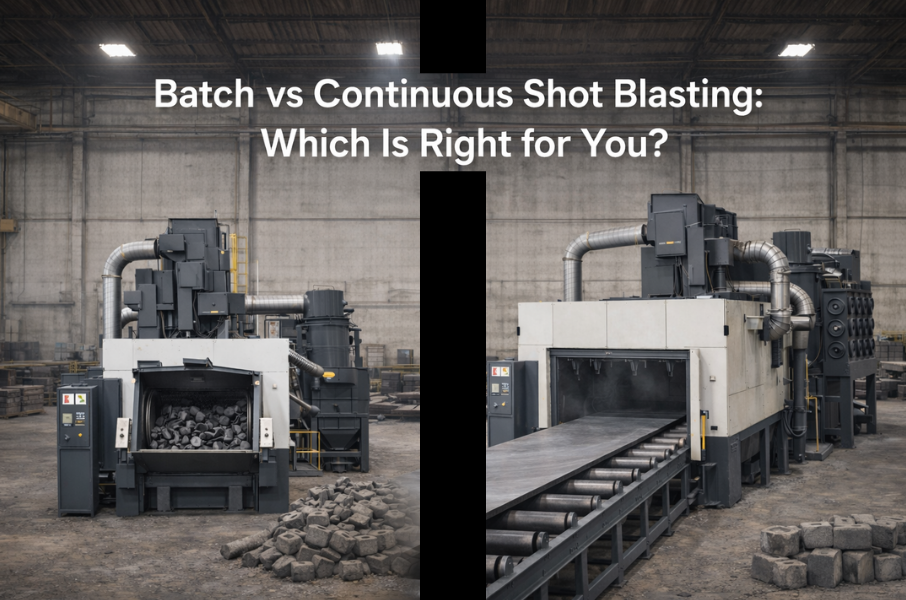
Batch systems, including tumblast, spinner hanger, and hook-type machines, are ideal when part variety is high and dispatch mix changes frequently. They handle mixed geometry and variable lot sizes better than rigid flow systems.
Typical strengths of batch architecture include:
- Lower initial investment and faster implementation
- Greater adaptability across changing component families
- Practical use in facilities with limited floor space
- Easier deployment where automation maturity is still growing
Batch systems are often preferred in fabrication workshops, job shops, and manufacturers serving multiple sectors with diverse part requirements.
Common batch-system pitfall
Flexibility can hide inconsistency. If loading discipline is poor, exposure uniformity suffers. Overloaded baskets, uneven hanging, and rushed cycle transitions lead to finish variability. Strong SOPs and operator training are mandatory for repeatable results.
Where continuous systems outperform
Continuous systems, such as roller conveyor and monorail lines, excel in repetitive high-volume production with stable part dimensions. They are built for flow, repeatability, and process integration.
Typical strengths include:
- High throughput with predictable cycle behavior
- Better consistency for standardized part geometry
- Strong compatibility with inline coating systems
- Reduced manual handling in mature layouts
If your business serves long-run production schedules with strict dispatch reliability, continuous systems often provide better long-term productivity.
Throughput evaluation must use net output, not nominal rating
Machine catalogs show impressive theoretical capacities, but real output is shaped by loading continuity, maintenance quality, and process synchronization. A continuous machine with irregular feed can underperform. A batch machine with optimized loading can exceed expectations.
Evaluate machines using net good parts per shift, including:
- Loading and unloading time
- Quality hold and rework rate
- Planned and unplanned downtime
- Downstream queue effects
This gives a realistic basis for business decisions.
Quality repeatability and customer commitments
Both system types can achieve required cleanliness and profile standards. However, repeatability mechanisms differ. Continuous systems naturally support stability for uniform parts. Batch systems rely more on disciplined setup and handling.
If your contracts include strict finish consistency across large volumes, prioritize control features, monitoring access, and maintenance support in the evaluation process.
Labor, safety, and ergonomics considerations
Machine choice influences workforce design. Batch setups may involve higher manual handling intensity, especially for mixed and heavy components. Continuous systems can reduce repetitive movement and improve ergonomic outcomes when integrated with conveyors and fixtures.
At the same time, advanced automation requires stronger maintenance and controls capability. Selection should match available technical depth, not only desired future state.
Capex versus lifecycle cost
Batch systems are usually attractive on capex. Continuous systems involve larger initial spending across machine, handling, layout, and integration.
But purchase price alone is a weak decision metric. Lifecycle economics should include:
- Abrasive consumption and recovery efficiency
- Power usage per processed ton
- Labor hours per batch or shift
- Spare parts and wear life
- Downtime impact on dispatch
- Rework and quality complaint cost
For stable high-volume operations, continuous lines often win on unit economics over time. For variable production with shifting demands, batch systems frequently provide better resilience and return.
Layout and expansion strategy
Physical layout constraints can decide feasibility. Continuous lines require coordinated infeed, blasting, outfeed, inspection, and often coating transfer paths. Batch systems are easier to place in constrained spaces.
However, decisions should include future expansion. If projected demand growth is high, choose a layout that supports incremental automation, parallel stations, or material handling upgrades without major reconstruction.
Reliability framework should be defined before purchase
Performance depends on maintenance strategy more than machine category. Turbines, liners, separators, filters, valves, and conveyors need preventive planning.
Pre-purchase planning should define:
- Critical spare list and stocking policy
- Routine inspection intervals
- Team skill requirements and training schedule
- Escalation pathway for breakdowns
Machines fail less when support systems are designed up front.
Decision model that avoids bias
Use a weighted scorecard across technical and business criteria:
- Part mix variability
- Throughput stability requirement
- Quality consistency expectations
- Workforce and skill profile
- Space and layout constraints
- Integration with upstream and downstream lines
- Budget and lifecycle targets
This method reduces bias from vendor presentations and helps teams align on objective trade-offs.
Commissioning and ramp-up strategy after machine selection
The first ninety days after installation are critical. Many projects assume performance is fixed once the machine is commissioned, but early operating discipline has a huge impact on long-term outcomes. During ramp-up, teams should track actual throughput, loading pattern variation, quality drift, and downtime causes daily.
For batch systems, early focus should be on loading standardization, cycle tuning, and operator consistency. For continuous systems, attention should center on feed synchronization, transfer stability, and process balancing across infeed and outfeed zones. In both cases, unresolved startup habits become permanent inefficiencies if not corrected quickly.
Commercial risk control in procurement decisions
Beyond technical comparison, procurement strategy should include risk safeguards. Contracts should define performance acceptance criteria, training scope, spare part timelines, and response commitments for commissioning support. Without these terms, even a technically good machine can create operational delays.
Plants should also evaluate vendor capability in local support, preventive maintenance planning, and process troubleshooting. Long-term performance depends on service ecosystem quality as much as machine hardware.
Industry-specific selection examples
Different sectors require different priorities. Foundries with mixed casting geometry often benefit from batch flexibility. Steel processing lines with uniform plate or section flow often gain more from continuous systems. Heavy fabrication with project-driven output may need a hybrid strategy, starting with batch and adding semi-continuous handling as volume grows.
Mapping machine selection to industry behavior helps avoid one-size-fits-all mistakes and improves return on capital.
Governance model after deployment
Once the machine is live, governance should include monthly review of throughput, rejection, downtime, abrasive consumption, and maintenance cost per processed ton. These reviews help leadership detect performance drift early and prioritize improvement investments.
A governance model converts equipment ownership from passive operation into active performance management.
Mistake to avoid
Do not size the machine only for occasional peak demand. Oversized systems can run inefficiently in normal conditions, raising cost per part. Build for stable demand and define overflow strategy separately.
Final takeaway
Batch and continuous systems are both excellent tools when matched to the right operating context. Choose batch when flexibility and mixed-job adaptability are core priorities. Choose continuous when repeat flow, high throughput, and integrated automation are strategic drivers.
The winning decision comes from process data, realistic constraints, and lifecycle thinking. When selection is aligned with real production behavior, blasting performance improves, quality stabilizes, and capital investment delivers sustained value.