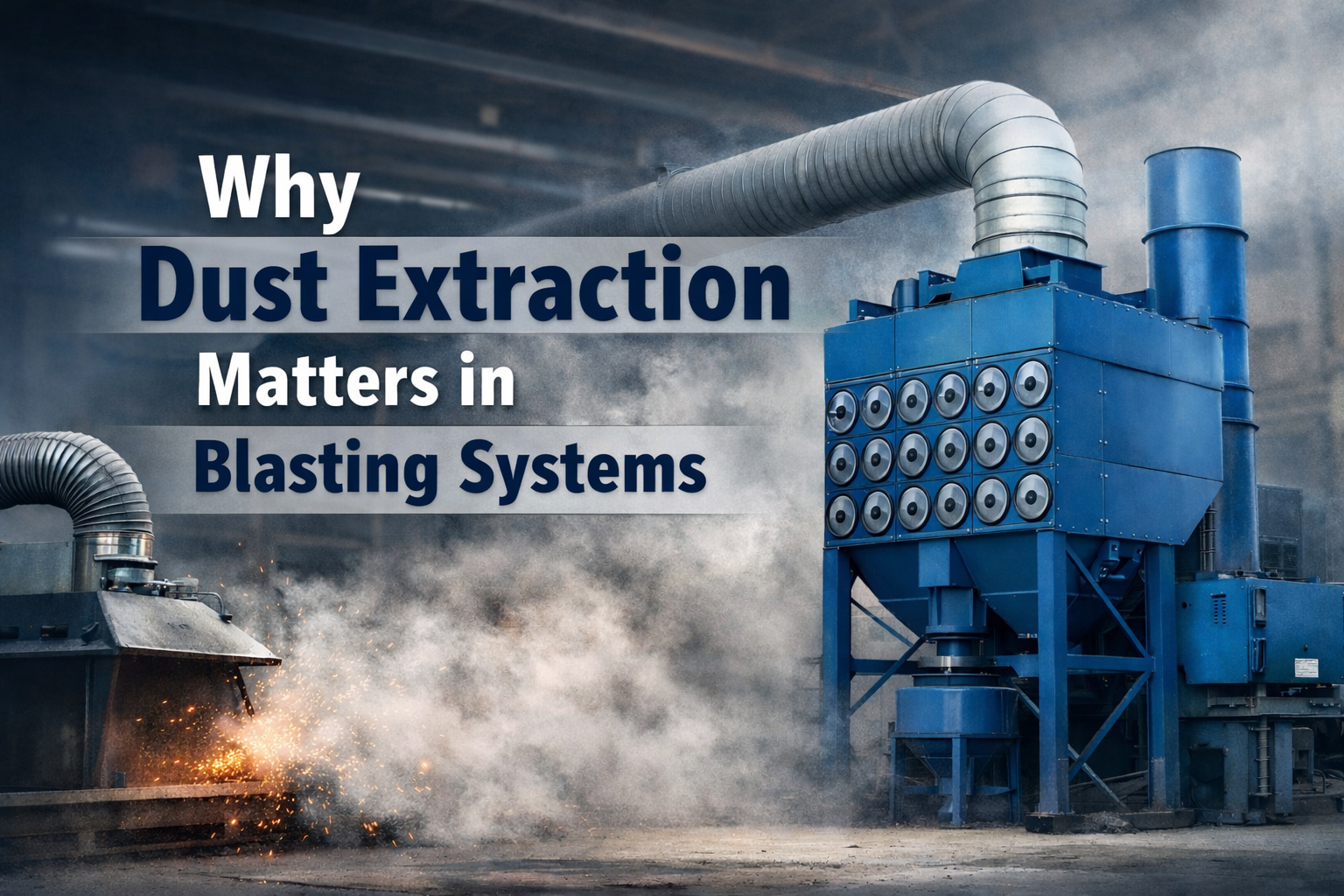
Dust extraction is a process control tool
In many shot blasting projects, dust extraction is treated as a utility added at the end of machine design. This is a costly mistake. Dust handling is a primary process control layer that affects finish quality, abrasive behavior, machine reliability, workforce safety, and compliance outcomes.
When extraction is under-designed or poorly maintained, problems appear everywhere: inconsistent profiles, reduced visibility, high abrasive contamination, rapid wear of components, and rising housekeeping load. Teams often attempt to fix these issues by adjusting blasting parameters alone, while the true root cause remains unresolved.
Dust is not waste, it is process feedback
Every blasting cycle produces a mixture of usable media, broken abrasive, rust scale, coating debris, and fine dust. The extraction and separation system must continuously remove unwanted particles while preserving reusable abrasive quality.
If this balance fails, fines recirculate and interfere with blasting energy transfer. Surface finish becomes inconsistent, cycle time drifts, and coating preparation quality declines. Monitoring dust behavior therefore provides direct insight into process health.
Quality impact of poor dust control
High dust loading inside the blasting circuit reduces operational visibility and contaminates reclaimed media. This lowers process stability and increases the chance of uneven cleaning patterns.
Common quality symptoms include:
- Variation in apparent cleanliness across the same component
- Inconsistent texture on edges and recesses
- Increased dust residue before coating
- Rising rework after visual or adhesion checks
These symptoms are often misattributed to abrasive grade or turbine wear alone. In practice, extraction imbalance is frequently the dominant factor.
Reliability and maintenance consequences
Fine particulate circulation accelerates wear in turbines, liners, valves, separators, and ducting. If extraction performance drops gradually, component wear may appear sudden because the system is compensating silently until limits are reached.
Plants then face recurring unplanned shutdowns, higher spare consumption, and unstable maintenance budgets. Proper extraction control stabilizes wear patterns and enables planned intervention rather than emergency replacement.
Safety and compliance implications
Dust control quality directly affects workplace conditions. Poor extraction increases suspended particulate near loading and unloading zones, impacting operator exposure and floor cleanliness.
A robust system with effective filtration, sealed transfer points, and disciplined maintenance supports safer operations and easier compliance with industrial hygiene expectations. This is especially important for facilities running multi-shift schedules with high daily throughput.
Why sizing errors are common
Extraction systems are often sized from generic machine dimensions rather than real dust generation behavior. Other design gaps include ignoring duct pressure losses, poor pickup placement, and mismatch between fan characteristics and filter resistance.
A proper design basis should include:
- Actual media circulation rate
- Part contamination load by product mix
- Chamber leakage profile
- Duct geometry and static losses
- Filter media performance under expected duty cycle
Correct sizing is not about maximum airflow. It is about stable, balanced airflow matched to process needs.
Differential pressure monitoring is a critical control
Filter loading increases pressure drop over time. If pulse cleaning and maintenance routines are not tuned, suction degrades and process performance slips. Differential pressure trend monitoring gives early warning long before visible dust issues appear.
Define operating bands, warning thresholds, and action limits. This converts filter maintenance from reactive to predictive.
Separation efficiency and abrasive quality management
Extraction and separator performance are interdependent. Weak separation allows broken fines and contaminants to recirculate with usable media. This reduces effective impact, increases cycle time, and degrades profile consistency.
Routine abrasive sampling, separator tuning, and reclaim checks are essential for long-term process stability. These tasks should be part of standard production planning, not occasional troubleshooting.
Energy efficiency without compromising quality
Dust extraction contributes significantly to blasting plant power consumption. Efficiency can improve through optimized fan operation, leakage control, and timely filter maintenance.
However, reducing airflow below process requirement to save power is counterproductive. The right target is optimized airflow for consistent blasting quality at minimum necessary energy, not minimum possible suction.
Integration with production management
Extraction performance should be managed jointly by production and maintenance teams. If production schedules ignore filter checks, hopper cleaning, and inspection windows, deferred maintenance accumulates and instability rises.
A practical model includes short, frequent maintenance intervals integrated into shift plans. This reduces dependence on disruptive shutdowns and keeps system behavior within control limits.
Useful KPIs for ongoing control
Facilities can improve quickly by tracking a focused KPI set:
- Differential pressure trend by shift
- Filter cleaning event frequency
- Fan power trend versus throughput
- Abrasive contamination indicators
- Rework rate tied to surface inconsistency
- Wear part replacement interval stability
These metrics connect extraction behavior with quality and cost outcomes, enabling data-led decision making.
Troubleshooting map for recurring dust issues
When dust-related problems repeat, a structured troubleshooting map improves response speed. Start by classifying the symptom: chamber haze, abrasive contamination, high filter pressure, poor visibility, or external dust leakage. Then verify the most likely causes in sequence, such as duct blockage, pulse cleaning failure, seal damage, fan imbalance, or separator drift.
A documented troubleshooting flow prevents teams from making random parameter changes that temporarily hide the issue while worsening long-term stability.
Preventive maintenance frequencies that improve uptime
Maintenance intervals should reflect usage intensity. High-duty operations may need daily visual checks, weekly pressure trend analysis, monthly filter and duct inspection, and quarterly airflow balancing. Lower-duty facilities can use longer intervals but should still maintain trend-based monitoring.
The key principle is consistency. Irregular maintenance causes abrupt performance drops that are harder and more expensive to recover from.
Cross-functional ownership model
Dust control performs best when ownership is shared. Maintenance ensures mechanical health, production ensures operating discipline, quality verifies process outcomes, and EHS monitors workplace exposure. If one function manages the system alone, blind spots remain.
Cross-functional review meetings help align priorities and accelerate corrective action closure.
Upgrade triggers for older systems
Older plants should define clear triggers for retrofit or upgrade decisions. Common triggers include persistent high differential pressure, repeated compliance observations, excessive wear part consumption, and chronic surface inconsistency linked to contamination.
Targeted upgrades such as improved filter media, duct rebalancing, or separator redesign can often deliver major gains without full system replacement.
Training agenda for operators and supervisors
Training should cover not only control panel operation but also process consequences. Teams should learn how dust behavior affects profile quality, abrasive life, and coating adhesion. They should also practice early symptom identification and escalation protocol.
When operators understand process physics, intervention quality improves and false alarms reduce.
Improvement roadmap for existing plants
A practical upgrade sequence includes:
- Baseline audit of airflow, pressure, and leakage points
- Validation of filter media and pulse cleaning settings
- Duct routing review for pressure optimization
- Separator cut efficiency calibration
- SOP revision for inspection and maintenance
- Operator training on early warning signs
Most plants can achieve measurable improvement in quality consistency and uptime within a short cycle when this roadmap is executed with accountability.
Human factors still matter
Even with strong hardware, results depend on execution discipline. Operators should be trained to identify chamber haze, abnormal dust carryover, or sudden finish variation early. Supervisors should respond with defined escalation steps rather than ad hoc adjustments.
Final takeaway
Dust extraction is not an accessory around a blasting machine. It is a core process subsystem that determines quality repeatability, equipment reliability, safety conditions, and operating economics.
When extraction is engineered correctly, monitored continuously, and maintained proactively, blasting performance becomes more stable and scalable. For any organization seeking lower rework, cleaner output, and longer equipment life, strengthening dust control practices is one of the highest-impact investments available.