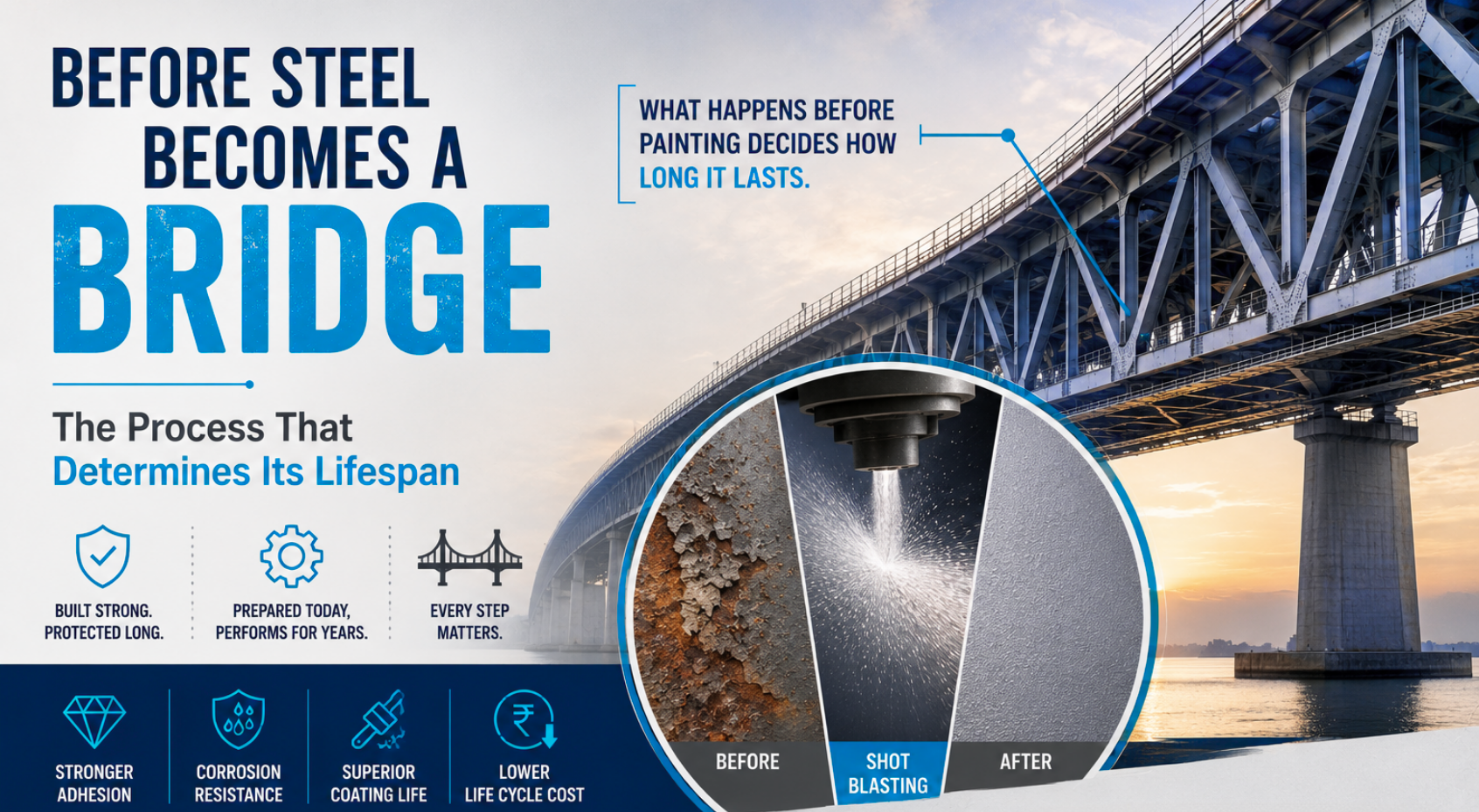
Before Steel Becomes a Bridge: The Process That Determines Its Lifespan
Stand beneath a steel bridge for a moment and look up.
You will see massive beams stretching from one end to another. Bolts holding tonnes of steel together. Layers of coating protecting the structure from rain, heat, dust and years of changing weather.
Most people see a bridge. An engineer sees thousands of decisions.
The grade of steel, the thickness of the sections, the welding and the load calculations. The coating system.
But there is one decision that almost nobody standing beneath that bridge will ever think about.
What happened to the steel before it was painted?
That question matters more than it sounds.
The Story Begins Long Before the Bridge
Before a steel beam becomes part of a bridge, it has a much less glamorous life.
It moves through manufacturing units and fabrication shops. It is cut, handled, welded and stored. Along the way, its surface collects mill scale, oxidation, rust and other contaminants.
Then comes the exciting part, the structure starts taking shape. Drawings become sections. Sections become assemblies. Slowly, something that existed on paper begins to look like a bridge.
At this stage, painting can feel like the finishing touch. Clean the steel, apply the coating and send it forward. Simple, right?
Not quite, because paint is only as dependable as the surface beneath it.
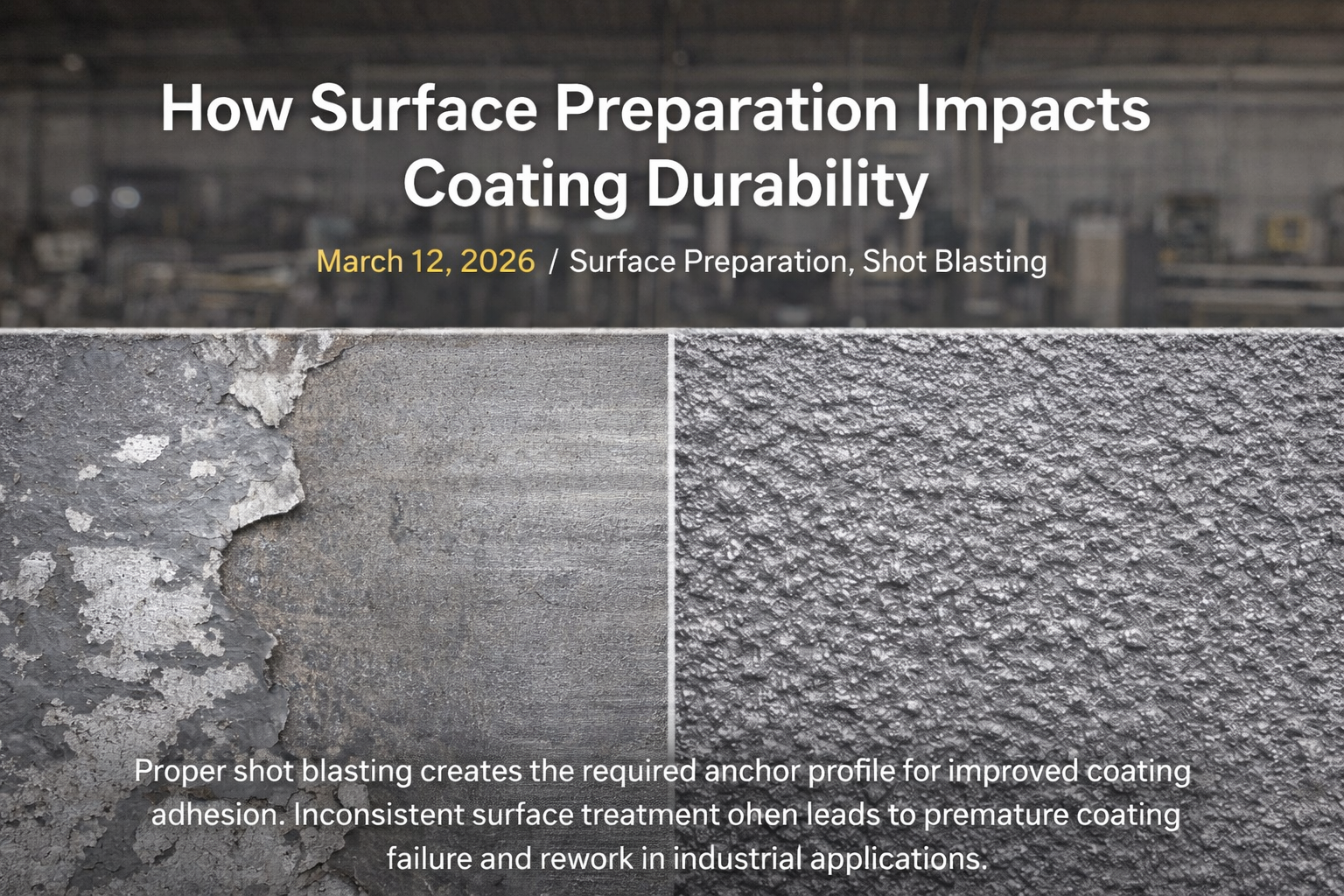
A steel surface may look clean to the human eye and still be poorly prepared for coating. The mill scale can remain tightly attached. Rust may sit in difficult areas. The surface profile may not be suitable for the coating system.
Apply an expensive coating over a poorly prepared surface and the problem does not always appear immediately.
That is what makes it dangerous. The bridge may look perfect on day one. The failure can begin quietly underneath.
The Problem Nobody Sees Until Later
Imagine a freshly painted steel beam. The coating is smooth, and the colour is uniform. Inspection from a distance looks satisfactory.
Months and years pass. Moisture finds a weak point, corrosion begins beneath the coating. A small section starts losing adhesion. The paint blisters or peels. Suddenly, the question is, “Was the paint bad?”
Sometimes, the paint was never the real problem. The real mistake happened before the first coat was applied.
Surface preparation plays a critical role in creating the cleanliness and surface profile needed for coating adhesion. SPT Blastech itself designs its surface preparation systems around uniform surface profile, coating adhesion and process stability for industrial applications. This is where shot blasting enters the story.
Not as a cosmetic cleaning process. As preparation for everything that comes next.
What Shot Blasting Actually Does to Steel
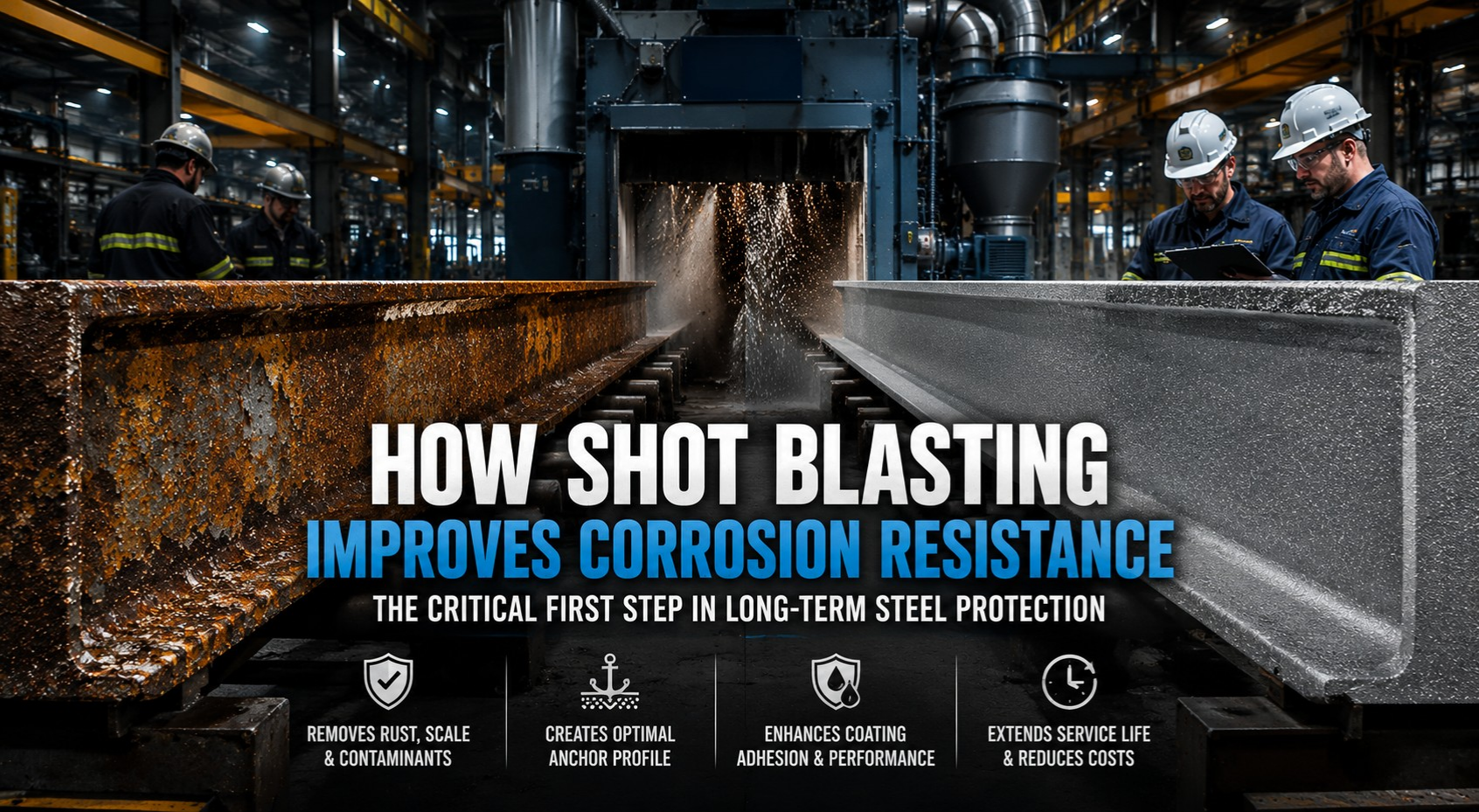
Inside a shot blasting machine, abrasive media is propelled at high velocity against the steel surface. Thousands of impacts work across the material.
Rust is removed, mill scale is stripped away and surface contaminants are cleared.
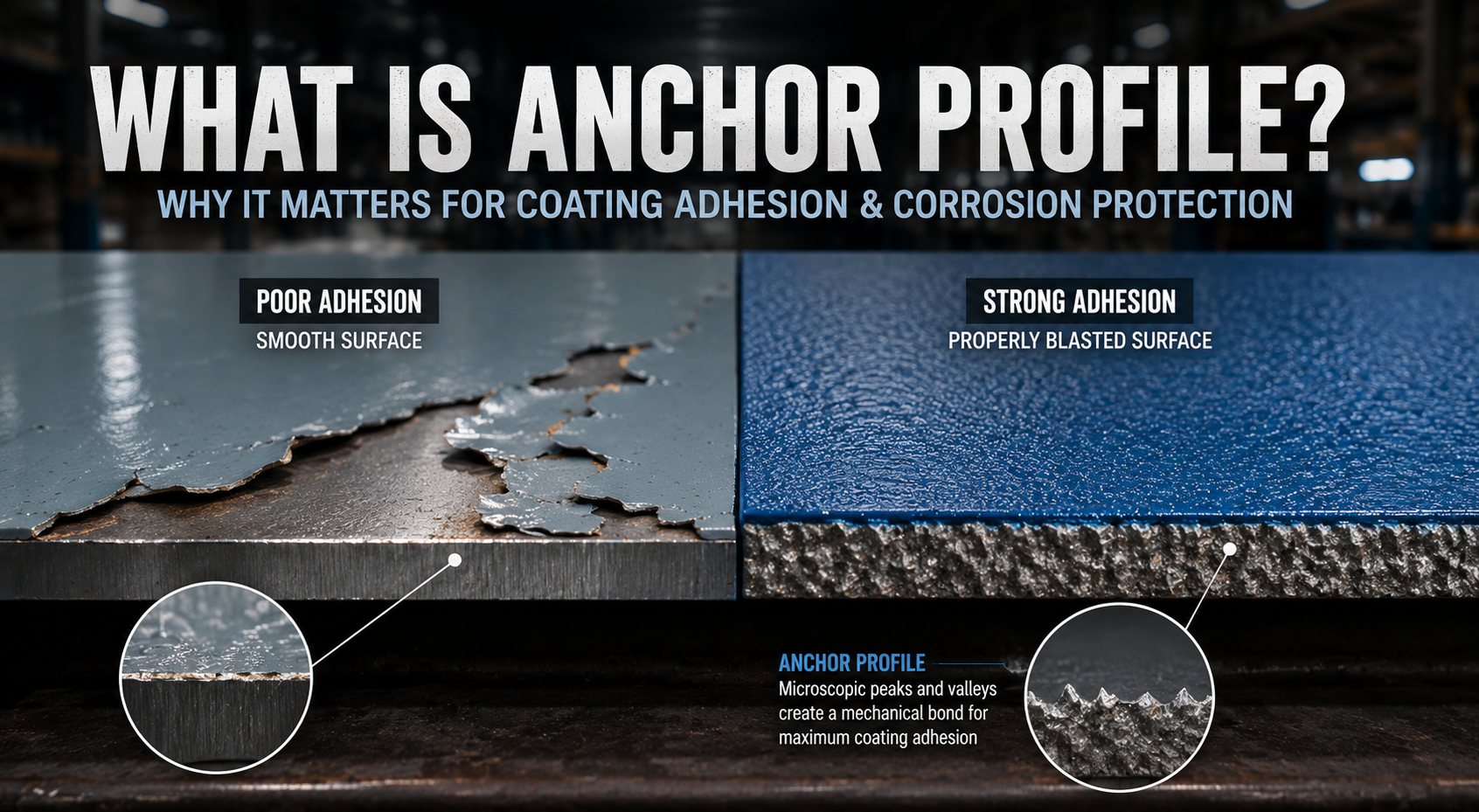
But the process does something else that is equally important. It creates a controlled surface profile that helps the coating establish better mechanical adhesion with the steel.
The beam that enters the machine and the beam that leaves it may have the same dimensions. But from a surface preparation perspective, they are not the same beam anymore.
One carries the history of manufacturing on its surface. The other is being prepared for protection.
For structural steel and fabricated sections, systems such as roller conveyor shot blasting machines can be engineered around component geometry, production volume and required surface finish. SPT Blastech highlights this application-specific approach across its structural steel and fabrication solutions.
And in bridge manufacturing, consistency matters.
A bridge is not built from one small steel plate.
There may be long beams, heavy sections and fabricated components moving through production. Surface preparation needs to remain controlled across component after component.
Because one poorly prepared area does not care how well the rest of the beam was cleaned.
A Bridge Fights a Battle Every Day
Once installed, bridge steel does not live in a factory-controlled environment. It faces moisture, pollution, temperature changes and dust.
In some environments, salt and aggressive contaminants add another challenge. The steel cannot ask for better weather.
Its protection depends on the system engineers gave it before installation. That is why coating durability begins much earlier than the paint booth.
It begins when manufacturers decide how seriously they will treat surface preparation.
At SPT Blastech, shot blasting systems are designed with factors such as abrasive recovery, dust extraction, process stability and application-specific engineering in mind. The company manufactures surface preparation systems for industries including fabrication, structural steel and heavy engineering.
Because in industrial production, cleaning steel once is not the challenge. Achieving a consistent surface, repeatedly, is.
The Process Nobody Will Photograph
When a bridge finally opens, cameras capture the finished structure. People photograph the first vehicle crossing it.
Engineers admire the scale. The public sees the result. Nobody takes a photograph of the steel beam on the day it entered a shot blasting machine. Nobody remembers the abrasive striking its surface. Nobody celebrates the mill scale being removed.
And perhaps that is the strange thing about good engineering. Some of its most important work becomes invisible once the job is done.
Years later, when a steel structure continues to perform in demanding conditions, its story is not only about what was built.
It is also about how the steel was prepared before the world ever saw it.
Because before steel becomes a bridge, it must first be prepared to survive as one.